Prepared 26 September 2026. This biography brings together official records, contemporary reporting, published interviews, publicly available book excerpts, photographs, and scholarship. It distinguishes established dates from retrospective testimony. Translations and interpretations are the author’s; no scenes or dialogue have been invented. A companion local media catalogue preserves the collected photographs and recordings.
The visitors had left, and the president could no longer keep up appearances. In Chang Tsu-yi’s recollection, Chiang Ching-kuo had endured a long audience with the physicists Wu Ta-you and Chen-Ning Yang before pain overwhelmed him. Chang called for a footstool, an aide, and a doctor. The man whose public voice he helped compose could scarcely stand. Decades later, Chang still remembered the distress of discovering how much suffering had been hidden beneath official composure. This is Chang’s remembered scene, not a contemporaneous medical record. It appears in an excerpt from his last book. GVM’s published excerpt
That encounter captures both the value and the danger of Chang’s testimony. He saw things that a distant historian could not see. He also loved the man he was describing. The suffering body made an indelible impression; the suffering caused by the political system around that body received much less attention in his affectionate account.
Chang’s life requires both perspectives. He was a remarkably durable craftsman of government prose, an intermediary close to consequential decisions, and an unusually productive centenarian. He was also a beneficiary and servant of an authoritarian order whose virtues he continued to defend after Taiwan had acquired the freedom to dispute them. His gentleness in old age and his partisan historical judgments belong to the same biography.
The essential record
| Item |
Established information and qualifications |
| Name |
張祖詒; simplified 张祖诒; Chang Tsu-yi in this biography, also searchable as Zhang Zuyi. |
| Birth |
1918, Changshu, Jiangsu. A 2023 memorial notice gives 19 June 1918; this research did not locate a birth registration. |
| Death |
24 May 2023, at home, according to his wife and contemporary reporting. |
| Age |
Obituaries generally say 105. The reported birth date would make him 104 completed years at death. Birthday and publishing stories often use nominal Chinese ages. |
| Education |
Shanghai Law School; a 2015 interview dates graduation to 1939. National Defense Research Institute training is also reported, without a verified attendance date here. |
| Principal office |
Deputy Secretary-General, Office of the President, 1 June 1978–31 October 1988, according to the official roster. He was deputy, although some headlines and video captions omit the word. |
| Earlier and later work |
Executive Yuan staff and Deputy Secretary-General; subsequently a national policy adviser. |
| Association with Chiang Ching-kuo |
Approximately 1972–1988, spanning Chiang’s premiership and presidency—not sixteen years in the presidential deputy secretary-general position. |
Sources: Presidential Office roster, CNA obituary, memorial notice reporting the birth date, 2015 interview.
A childhood between the classics and modern law
Chang grew up in Changshu, in the Jiangnan cultural world south of the Yangtze. His own account begins with a private tutor who held the old xiucai qualification. His father encouraged poetry; the boy preferred prose. A school strike prompted his transfer to the middle school affiliated with Soochow University. The distinction matters: the account describes secondary schooling at Soochow, not a university degree there.
He subsequently studied at Shanghai Law School. After war broke out in 1937, the school moved into Shanghai’s concessions and costs increased. A professor helped him obtain paid work with a cotton-control body under the Ministry of Industries, allowing him to continue until graduation in 1939. These details are retrospective testimony. Global People interview, 2015
The juxtaposition is suggestive: classical verbal discipline, modern legal education, and an early encounter with the administrative state. It offers a plausible background for his later precision with official language. It does not establish an inevitable path to the Presidential Office. The available sources leave a substantial gap between his graduation and his documented work in Taiwan around 1960. A continuous, dated account of his mainland employment, wartime movements, and migration to Taiwan would require further archival work.
That gap should remain visible. The familiar outline of Nationalist retreat cannot substitute for this particular man’s itinerary.
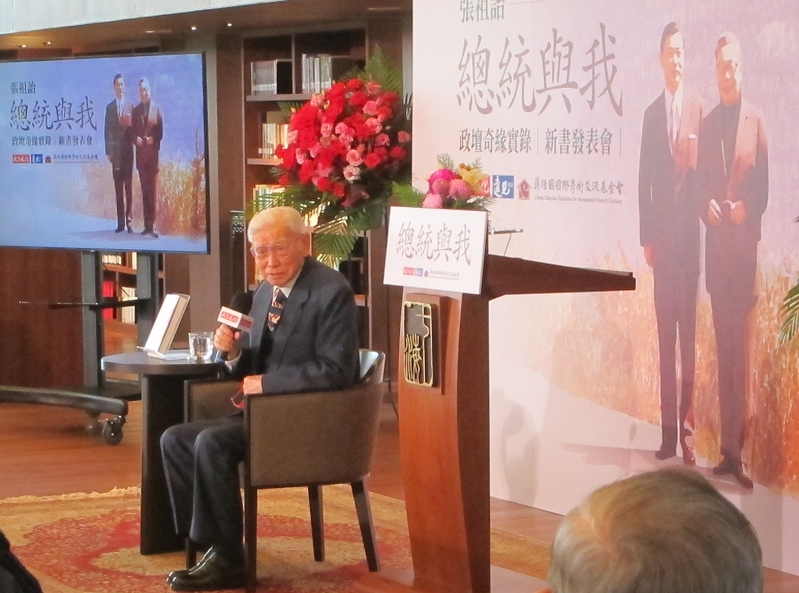 Chang speaking at The President and I book launch, 10 February 2022. Photograph: Zhong Yuan / The Epoch Times. Source · P030
The family connection to Hu Shih
Chang’s first wife, Chiang Hsiao-po / Jiang Xiaobo (江小波), was a niece of Chiang Tung-hsiu / Jiang Dongxiu (江冬秀), Hu Shih’s wife. Hu was therefore Chang’s uncle by marriage, rather than a blood uncle. A Hu Shih Memorial Hall obituary, preserved in a public repost, describes a relationship expressed through practical care.
At Hu’s seventieth-birthday gathering in December 1960, Chang offered to help arrange a red-and-black facsimile of Hu’s treasured Jiaxu manuscript of The Story of the Stone. Then a secretary at the Central Engraving and Printing Plant, he helped carry the project through to completion in June 1961. When Hu recuperated after a heart illness that year, Chang also took turns keeping watch at night, accepting the Monday and Tuesday shifts. Memorial Hall obituary, preserved by the Hu Shih research blog
Here was a version of service with no presidential podium: accounts, printing arrangements, and an elderly man who should not be left alone. It is useful evidence against reducing Chang to his government title. Books and companionship were part of his public life before his own books became news.
The connection survived Hu’s death. The Memorial Hall’s photographs place Chang at its December 2014 scholarship ceremony and again at the December 2019 event associated with Kao Hsin’s donation of Hu’s letters to his grandfather Kao Tsung-wu. These institutional records corroborate his continued participation; they do not merely repeat an obituary’s praise. 2014 ceremony, 2019 ceremony
There is a revealing intellectual tension here. In a 2012 television interview, Chang acknowledged Hu’s commitment to freedom and democracy while presenting Hu and Chiang Kai-shek as sharing national objectives despite different approaches. That conciliatory reading tells us something about Chang’s habitual method: he looked for a common moral purpose behind disagreements among the elders he respected. NTD report and interview
Learning another man’s voice
Before Chiang Ching-kuo became his principal, Chang wrote for Yen Chia-kan (嚴家淦). In later interviews, he recalled approximately six years of editorial work during Yen’s premiership. The change of administration in 1972 initially seemed likely to end that arrangement. Chang submitted a resignation with the outgoing team, only to learn that Chiang wanted him retained. He said he studied Chiang’s previous speeches to prepare an initial policy address; the resulting draft was used without alteration. Anke interview
This is an origin story told by its beneficiary, and its dramatic perfection should be recognized. Yet its underlying professional problem is entirely concrete. A successful government writer must understand policy, the intended audience, and the superior whose authority the text will carry. The task is more demanding than decorative eloquence. A speech that sounds impressive but alien to its speaker can fail politically.
Chang became known as Chiang’s 文膽, conventionally translated as “principal speechwriter” or “literary aide.” The expression suggests a trusted source of language and judgment. It should not be read as proof that every consequential sentence attributed to Chiang originated with Chang; the sources do not provide a comprehensive manuscript-by-manuscript attribution.
In a 2017 account, Chang remembered writing speeches and policy reports with a brush. He also described duties extending to coordination between party and government. When he protested that he did not understand factional politics, Chiang allegedly regarded that distance as an advantage. The most affecting recollection was of Chiang saying he needed Chang emotionally as well as professionally. Whether remembered word for word or shaped by the intervening decades, the story shows how Chang understood the relationship: trust was personal, and gratitude became a lasting obligation. Merit Times profile, 2017
Former foreign minister Fredrick Chien / Chien Fu (錢復) later praised the accessibility of Chang’s writing, contrasting it with difficult allusions and obscure language. Clear prose was part of his reputation, not simply a modern reader’s assumption about his style. 2023 memorial notice recalling Chien’s assessment
Clarity itself has a political double edge. It can make government accountable and understandable. It can also make a leader’s preferred version of events persuasive. Chang’s professional achievement cannot be assessed solely by counting elegant paragraphs; one must also ask whose authority those paragraphs served.
 Chang (right) with Chiang Ching-kuo in the Executive Yuan auditorium. Family-supplied photograph; exact date not established. Source · P038
Office, access, and the economic state
The official appointment record is firmer than the anecdotes. The government personnel database maintained by National Chengchi University records his appointment as Executive Yuan Deputy Secretary-General on 7 December 1973. An appointment order for the presidential deputy position followed on 30 May 1978. The Presidential Office’s service roster dates the actual term from 1 June. Keeping the order date and tenure date separate resolves a common discrepancy. NCCU personnel records, official tenure roster
His proximity to economic decision-making was more substantial than the label “speechwriter” implies. Historian Hong Sao-yang (洪紹洋) discusses the economic group around Chiang, Yu Kuo-hwa, Li Kuo-ting, Sun Yun-suan, and Fei Hua, and explicitly uses material organized by Chang. That documentary afterlife is consequential: a staff officer’s records help historians reconstruct the government’s responses to exchange-rate changes, inflation, and the upheavals of the 1970s. Hong’s study, Archives, December 2024
This establishes a place close to deliberation and a role in preserving it. It does not make him the architect of the entire “Taiwan miracle.” Economic results depended on ministries, businesses, workers, international markets, and competing policy advice. Hong’s account of adjustment and difficulty is a useful corrective to commemorative writing that turns development into an uninterrupted sequence of one leader’s inspired decisions.
Chang’s importance lay partly in converting discussion into a usable institutional record. Someone had to identify what had been decided, communicate it, and give the next official an intelligible point of departure. Such work can be powerful without being highly visible. The distinction between a decision-maker and a trusted intermediary should be preserved without dismissing the intermediary as a mere stenographer.
His appointments also placed him inside the existing political order. In July 1986 he was appointed to a committee concerned with selecting additional overseas members of the legislature and Control Yuan under the mobilization-era system. That detail complicates an account presenting his whole career as a march toward open electoral competition. NCCU record of the 10 July 1986 appointment
Liberalization from inside an authoritarian government
Chang served at the center of a government that both restricted political freedom and eventually relaxed some of its central controls. During his presidential tenure, the Kaohsiung / Formosa Incident of December 1979 was followed by a sweeping crackdown and military or civilian prosecutions of opposition figures. The National Human Rights Museum’s account of Shih Ming-teh records the authorities’ treatment of the movement as a rebellion case. National Human Rights Memory Database
The sources examined here do not establish that Chang personally ordered that repression. It would be irresponsible to assign an individual operational role without evidence. It would be equally misleading to present his administrative competence in a vacuum, detached from the coercive system it helped sustain.
The strongest case for his contribution to liberalization concerns practical implementation. In a later published recollection, Chang described opposing a procedural delay over regulations accompanying the lifting of martial law, reporting the impasse to Chiang, and helping communicate the president’s insistence on proceeding. The exchange is revealing as testimony about how he saw his own usefulness. Its reconstructed dialogue and uncertain meeting identification should not be mistaken for verified cabinet minutes. Chang’s published recollection
The public outcome is independently documented. Chiang’s decree, dated 14 July 1987, ended martial law in the Taiwan area from 15 July. The lifting did not simultaneously apply to Kinmen and Matsu. Official historical accounts also acknowledge organized pressure from outside government, including opposition demonstrations, and the continued controversy over restrictive legislation. Original decree, National Archives account of democratic movements, National Archives exhibition
The balanced interpretation is that Chang could help a presidential decision survive bureaucratic friction. That is an achievement. It is smaller than inventing Taiwan’s democracy and more specific than simply being present when change occurred. Reform came through an interaction between social pressure, political calculation, institutional work, and decisions at the top. A biography of a presidential aide naturally magnifies the final two; it needs conscious correction to keep the first two in view.
Letting families cross the strait
The 1987 opening of visits to relatives on the mainland offers especially useful corroboration. In his 2016 New Year address, Ma Ying-jeou (馬英九) recalled that Chiang assigned the planning work to Chang, who instructed Ma to prepare the initial proposal. Ma described handwritten material kept under lock and key and the project name 穎考專案. The opening followed on 2 November 1987. This is still retrospective testimony, but it comes from a second participant speaking in an official public address. Ma’s 2016 address, Presidential Gazette
At Chang’s 2022 book launch, Ma again credited his former superior, describing the use of the Red Cross as an intermediary and the preparation of a workable plan. He also called Chang’s supervision exceptionally valuable training for his own public career. CNA’s book-launch report
The human stakes were immense: separated relatives could begin to discover what had happened to one another. Chang’s contribution is most credibly described as supervising and shaping the planning within the Presidential Office, alongside Ma and others, under Chiang’s authority. Describing him as the sole founder of cross-strait exchange, or collapsing this opening into all the later “Three Links,” would exaggerate the evidence.
There is also an instructive reversal of scale. The official’s world consisted of proposals, routing, discretion, and approval. The families’ world consisted of parents, children, aging bodies, and the possibility that someone had already died. Administrative decisions became intimate consequences. This is one place where his otherwise elusive staff work can be connected to an unmistakably human result.
Succession and the end of his principal career
Chiang’s death on 13 January 1988 ended their working relationship, but not Chang’s tenure as deputy secretary-general. He remained until 31 October under Lee Teng-hui (李登輝). An October resignation order and the end-of-month service date describe different administrative steps. Official roster, personnel orders
Chang’s later comments distinguish constitutional succession to the presidency from control of the Kuomintang. At the 2022 launch, he recalled Chiang declining to create party vice-chairmanships and suggested a preference for collective party leadership. He also criticized the speed of Lee’s elevation to acting party chairman. These are a loyal former aide’s recollections and judgments, not proof of a binding, secret succession plan. CNA report of Chang’s remarks
His relationship with Secretary-General Shen Chang-huan (沈昌煥) provides a small but telling case study in how political folklore develops. A commemorative account linked a gift of shoes to their departure from office. In a subsequent correction, Chang said the shoes were given after Chiang’s death and denied a prior agreement to resign together. He insisted that their departures came in October, roughly nine months later, rather than immediately after the death. He endorsed the description that the working environment had changed. Chang’s correction, Overseas Chinese Association Magazine, issue 145, p. 32
Even this correction is not a substitute for official dating: his “following day” recollection does not map neatly onto the administrative dates discussed in later scholarship. A study of Lee’s consolidation places Shen’s departure on 17 October and Chang’s resignation three days later. Academia Historica study of Lee’s political transition
The distinction is the point. A dramatic story of coordinated resistance is not established merely by the two men’s friendship and adjacent departures. What is secure is that Chang’s principal career ended during a broader transition away from Chiang’s immediate personnel circle.
Retirement did not erase all public obligations. A 5 January 1994 Presidential Office notice identifies him as a national policy adviser chairing a meeting of the office handling Yen Chia-kan’s funeral arrangements. Presidential Office notice
Companionship as a political assignment
One unusual assignment took Chang into the household of Chang Hsueh-liang (張學良), the “Young Marshal” associated with the 1936 Xi’an Incident and subsequent decades of confinement. In his later account, Chiang asked Chang and his wife to accompany the older couple on a visit to Kinmen and then to visit them regularly. Chang described friendship, conversation, outings, and meals over the ensuing years. The accompanying photograph identifies the two couples together. Published memoir excerpt and family photograph
Chang interpreted the assignment as evidence of Chiang’s generosity toward a lonely old man. A historian can recognize its warmth while also noticing the imbalance of power: companionship was being arranged by the leadership that controlled the older man’s circumstances. Kindness within a system of restriction does not settle the justice of the restriction itself.
For Chang personally, the story suggests a quality valued beyond his prose. He could be trusted to behave appropriately with someone whose historical significance and political sensitivity made ordinary social contact complicated. His wife was part of that work. The boundary between household sociability and official service was porous.
The trip’s precise date is not treated as settled here. Chang’s recollection places it in September 1979; other retellings associate a Kinmen visit with 1980. The photograph is therefore filed as undated, rather than given the memoir’s date by assumption.
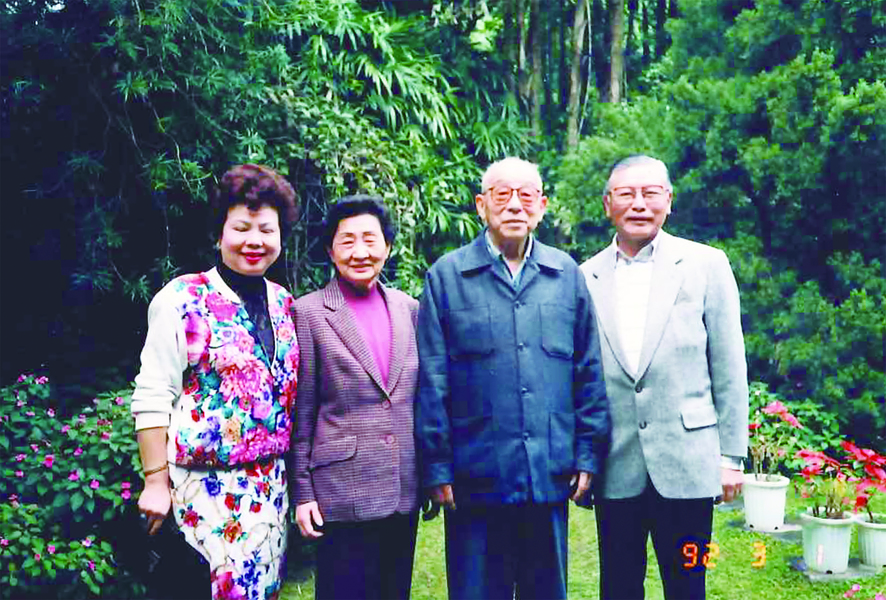 Chang (far right), his wife (far left), Chang Hsueh-liang, and Chao I-ti. Source identifies the group; exact date remains unverified. Source · P043
Two marriages, children, and the person at home
The first marriage is publicly documented through the Hu Shih connection, but the sources found do not reliably establish when it began or ended. They do not establish the circumstances in which Chang later married Chen Chia-li (陳家麗), also called Angela. Those absences should not be filled with guesses about bereavement, divorce, or the parentage of his children.
His later marriage is much more visible. In the 2019 50+ profile, Chen is an active presence: selecting his food, teasing him, explaining their habits, and sharing their enjoyment of old songs and dancing. The couple described a nightly practice of reconciliation and affection rather than carrying irritation into the next day. The photographs show both the elderly pair and an earlier period of their life together. 50+ interview
The domestic humor is valuable precisely because it punctures the grand public titles. The former presidential official cheerfully attributed his longevity to listening to his wife. It was a joke about authority, but also an acknowledgment of labor. His autonomy rested partly on another person’s sustained attention to meals, schedules, companionship, and reassurance.
His children also complicate the benign public image. In his centennial speech he accepted their teasing about his earlier temper, admitting that he had not always been an easy father. He told a story about arranging a trial stay at a retirement community for his son Chung-ning / Chongning (崇寧), then sixty-eight. An employee assumed that the caller was arranging accommodation for his own father. Chang had to explain that he was the father. The speech mentions both a son and a daughter participating in the celebration; it is not a complete family register. Centennial speech excerpt
The anecdote is funny because a familiar family task has become temporally dislocated: the son is old enough for a retirement community, and his father is still handling the arrangements. It also reminds us that extreme longevity is experienced by a family, not only by the celebrated survivor.
The warmth of these interviews should not be confused with unrestricted access to his private life. They are cooperative public encounters, often framed around successful aging. They reveal affection and wit; they cannot establish that a marriage was always harmonious or that family relationships were free of difficulty.
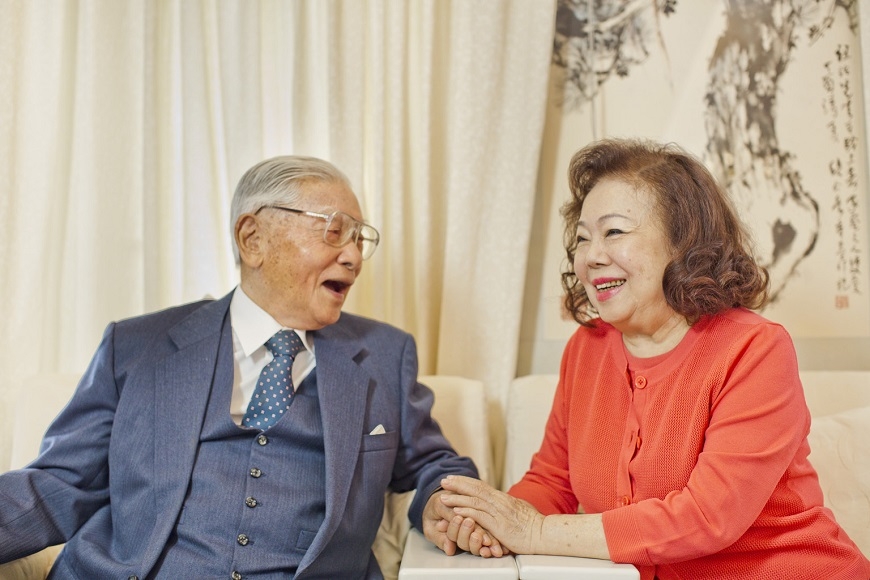 Chang with Chen Chia-li during the 50+ home interview, published in 2019. Source · P006
Faith, illness, and the daily work of remaining alive
Chang was a Christian. His own centennial remarks thank God and Jesus Christ, and give particularly emphatic credit to Angela’s care. His religious language was part of his self-understanding, rather than a label inferred only from his funeral. The date and circumstances of conversion were not verified. Centennial remarks
A 2017 interview supplies a less sentimental account of old age. Chang recalled surgery for early stomach cancer in his eighties, involving removal of a substantial part of the stomach. The reporter observed his insistence on getting up unaided and making his bed. His routine included regular meals, modest exercises, and golf; photographs show him on the course. He described writing according to energy and inclination, stopping when tired. United Daily News interview by Ho Ting-chao
There is no medical basis here for converting his habits into a proven explanation for living beyond a century. The observations are biographical: he valued agency, resisted unnecessary dependence, and had care and resources that helped make those choices possible. His religious trust did not mean refusing treatment; the accounts show substantial medical intervention alongside faith.
Nor was his final productivity effortless. In the preface to Laoshan Elegy, he wrote that heart illness, surgery, and three hospital admissions interrupted the manuscript. The physical cost belongs in the story alongside the publicity about a centenarian publishing another novel. Author’s preface reproduced in the publisher-supplied book listing
The most convincing image of his old age is therefore not invulnerability. It is continuity made through interruptions: sitting down again, returning to the page, accepting help, and preserving enough independence to keep the work his own.
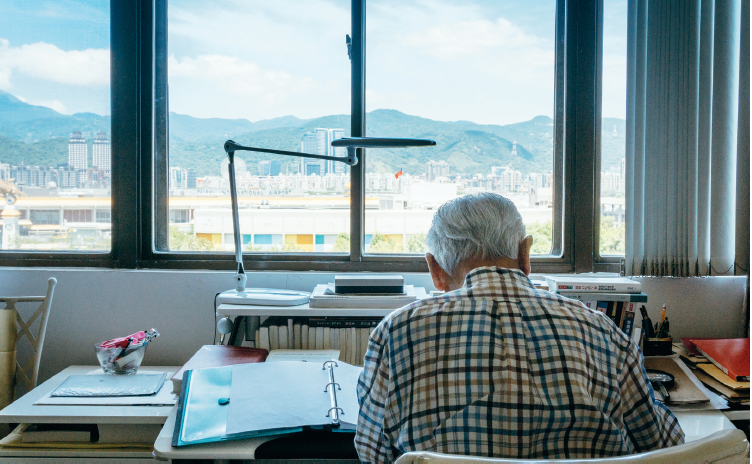 At his writing desk. Photograph published by Anke in 2021, illustrating an earlier interview; exposure date not confirmed. Source · P048
A retirement that became a second career
After leaving his principal office, Chang spent roughly two decades in North America, with travel and family visits featuring in later accounts. He eventually returned to Taiwan, with access to medical care given as a reason. Interview chronologies are approximate; the secure literary milestone is the publication of 《蔣經國晚年身影》 in 2009. Anke describes the invitation to write about his former chief as the stimulus for an unexpectedly vigorous new writing life. Anke profile, fuller publication, publisher’s 2009 book record
The professional reversal is striking. He had spent decades finding words acceptable to a superior. In retirement he could choose the subject, pace, form, and ending. Yet the old relationship remained the first subject he returned to. Freedom from office did not mean freedom from loyalty.
His first major memoir presented Chiang through work, policy, personality, and intimate observation. Its publisher’s page includes Ma’s recommendation and a preface emphasizing personal recollection. It is useful testimony about proximity and devotion; it announces neither the evidentiary apparatus nor the detached posture of an institutional history. Chiang Ching-kuo in His Later Years, publisher’s record and preface
The following books widened his range. 《帚珍集》 collected recollections and essays on public figures, historical experiences, and international affairs. 《現代逍遙遊》 and 《不亦快哉集》 gave travel, reflection, and the pleasures of later life greater space. 《再相逢》 is reported as his translation of a grandson’s foreign-language novel, although the original title, author’s full name, and publication details could not be securely established here. World Book publisher listing, 50+ account of the translation
Then came fiction. 《寶枝》 (Baozhi), published in January 2015, follows a woman through arranged dependency, love, war, displacement, and bereavement. Critic Lin Tai-man (林黛嫚) placed it in a tradition of social romance: intimate lives set against historical change, rendered in accessible realist prose. Her review also confronted an obvious objection—the abundance of decent and helpful people—and defended the artistic legitimacy of representing goodness. Lin’s review, National Museum of Taiwan Literature bibliography
Chang himself said that his fiction sought humane possibilities rather than dwelling on wickedness. That preference is consistent with the benevolent moral portraits of his memoirs. It is not a license to read the heroine as his first wife, or the novel as a concealed factual autobiography. Chang’s 2015 literary interview
《嶗山悲歌》 (Laoshan Elegy, 2021) is darker in its premise. Its subtitle foregrounds the ruin of a couple by national hatred. The publisher’s synopsis and prefaces describe a wartime love story involving religious and moral questions, suffering, and the destructive inheritance of conflict. The work’s relevance to Chang’s life lies in the continued pressure of the war generation’s memories. The characters and plot are fiction; this biography has consulted the public synopsis and prefatory material, not pretended to a cover-to-cover reading. Book listing, synopsis, and prefaces
His literary achievement should be measured in more than years lived. He undertook unfamiliar forms, sustained long narratives, and accepted editorial encouragement when most people of his generation were gone. Whether every book succeeds aesthetically is a separate question. Longevity can attract a reader; it cannot do the work of a sentence.
The record claim—and what can actually be verified
Press reports and supporters described Chang as a record-breaking oldest male writer. The publicity around Laoshan Elegy explicitly involved an ambition to surpass a longevity record. Some later reports called the distinction a Guinness record; GVM’s obituary described the status as unofficial. Laoshan Elegy preface, GVM obituary
This research did not locate a Guinness certificate or an official historical entry confirming Chang’s award. The Guinness page checked for “Oldest author (male)” instead lists Kim Hyung Seuk for a final manuscript accepted in March 2024. That current listing does not, by itself, prove Chang never held another record. It does mean that a confident claim of formal certification would exceed the evidence assembled here. Guinness record page
The secure distinction needs no inflation: he published substantial new writing at a very advanced age, including a novel in 2021 and another political memoir in 2022.
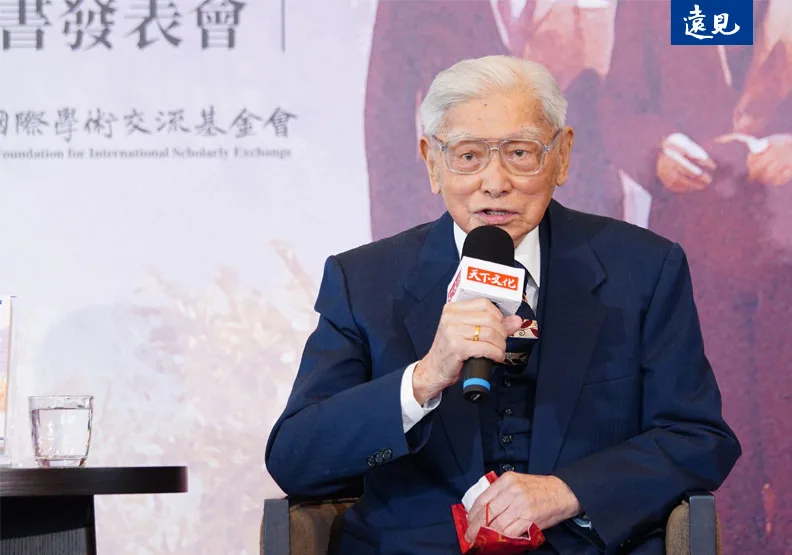 Chang at the February 2022 book launch. Photograph by 賴永祥, republished in GVM’s 2023 obituary. Source · P037
Loyalty, nationalism, and the contest over memory
《總統與我:政壇奇緣實錄》 (The President and I, 2022) returned Chang to the relationship that defined his public identity. Its preface makes clear that personal memory, rather than a retained diary or documentary apparatus, underlies the narrative. The book launch brought together prominent figures from his old political world, including Ma, Chien, and former vice presidents. Publisher’s expanded-edition record and preface, Awakening News launch report
The gathering demonstrated enduring esteem and a surviving network. It was also an act of political remembrance: these participants were interpreting a shared past for a Taiwan that no longer belonged to their administrative generation.
Chang’s loyalties remained sharp. In the book material reproduced by GVM, he criticized contemporary Taiwan’s leadership, its approach to China, and its alignment with the United States. These are his political judgments, not neutral descriptions of the international situation. They show that the gentle centenarian of lifestyle interviews was capable of combative polemic. Published closing passages
His treatment of the February 28 Incident of 1947 is the most important test of his reliability as a historical interpreter. Chang recalled reviewing Daxi archival files at Chiang Ching-kuo’s request and concluded that Chiang Kai-shek’s instructions demonstrated restraint. His argument sought to protect the elder Chiang from responsibility and treated some contemporary criticism as politically motivated. Public excerpt in The News Lens
That recollection cannot stand as the final judgment. The February 28 Memorial Foundation’s responsibility study assigns Chiang Kai-shek major responsibility, discussing his dispatch of troops, disregard of warnings, and subsequent protection of Chen Yi. The issue is not resolved by locating individual instructions urging restraint while disregarding the larger sequence of decisions and their consequences. Foundation research summary
In February 2023, Academia Historica president Chen Yi-shen (陳儀深) publicly rejected Chang’s suggestion that the relevant original files still needed to be disclosed without alteration, pointing to the 2008 publication of the Daxi materials. That exchange should be reported as a dispute over evidence and interpretation; an accusation of archival tampering is not an established fact. Newtalk’s report of Chen’s response
Chang’s position reveals a deeper limit. Gratitude to a patron can be an admirable personal trait while remaining a poor rule for judging state violence. His access strengthens his evidence about a conversation or working relationship. It does not give him exclusive authority over what that government meant to people outside the room.
There is nevertheless a reason to read him carefully instead of dismissing him. He preserves the moral vocabulary through which an educated Nationalist official understood service: personal trust, restraint, duty, cultivated language, kindness to associates, and continuity of the Republic of China. That vocabulary is itself historically important. Its silences are important too.
Death and the shape of the legacy
Chang died at home on 24 May 2023. His wife reported a peaceful death and said he had requested no formal obituary announcements or newspaper notices. A Christian memorial service was held at Grace Baptist Church (懷恩堂) in Taipei on 12 June. The reported attendance of roughly three hundred, including Ma and other former senior officials, made visible the network of family, faith, friendship, and public service around him. FTNN obituary, Awakening News report of the memorial
His legacy has several distinct dimensions. As an administrator, he exemplifies the consequential official who works through preparation, language, and access rather than personal mass appeal. As a witness, he left intimate evidence about Chiang’s last political years, which becomes more useful when tested against independent records. As a writer, he transformed retirement into a period of formal experiment and sustained production. As a family member, he appears in the public record as a husband grateful for care and a father able, late in life, to admit that he had once been difficult.
The dimensions do not cancel one another. An affectionate husband can defend an authoritarian past. A partisan memoir can preserve a valuable observation. A polished public servant can discover, after ninety, that he has not exhausted what he wants to say.
For much of his career, Chang’s best sentences disappeared into someone else’s voice. In his last decades, his own name moved onto the cover. The historical task is to hear that voice fully: its wit, discipline, tenderness, self-protection, and loyalties—and to keep listening when the testimony ceases to be comforting.
Chronology for reference
| Date |
Event |
Basis |
| 1918; 19 June reported |
Born in Changshu, Jiangsu |
Obituaries; memorial notice for exact day |
| 1930s |
Soochow-affiliated middle school; Shanghai Law School |
2015 interview |
| 1939 |
Reported law-school graduation |
2015 interview |
| By 1960 |
Secretary at the Central Engraving and Printing Plant; relative of Hu Shih by marriage |
Memorial Hall obituary |
| 1960–1961 |
Helps arrange Hu’s manuscript facsimile; participates in care during Hu’s convalescence |
Memorial Hall account |
| Approximately mid-1960s–1972 |
Writes for Yen Chia-kan’s Executive Yuan administration |
Later interviews |
| 1972 |
Retained to write for incoming premier Chiang Ching-kuo |
Multiple interviews |
| 7 December 1973 |
Appointed Executive Yuan Deputy Secretary-General |
Appointment database |
| 30 May / 1 June 1978 |
Presidential deputy appointment order / beginning of official tenure |
Appointment database / official roster |
| Late 1970s onward |
Social contact with Chang Hsueh-liang and his wife |
Memoir; exact trip date unresolved |
| 10 July 1986 |
Overseas supplemental-representative selection committee appointment |
Appointment database |
| 1987 |
Work associated with martial-law repeal and mainland family-visit planning |
Memoir; Ma’s testimony; official decree |
| 13 January 1988 |
Chiang dies; Chang continues in office under Lee |
Official roster and contemporary chronology |
| 20 / 31 October 1988 |
Resignation order / end of presidential deputy tenure |
Personnel record / roster |
| 5 January 1994 |
Identified as national policy adviser in Yen funeral arrangements |
Presidential Office notice |
| 2009–2022 |
Principal period of book publication |
Publisher and library records |
| 2017 |
Centennial celebrations using nominal-age convention |
Published photographs and interviews |
| 10 February 2022 |
The President and I launch |
CNA and other event reporting |
| 24 May / 12 June 2023 |
Death / memorial service |
Contemporary news |
Annotated bibliography of his books
English renderings below are descriptive translations, not verified titles of English-language editions.
| Year |
Work |
Form and bibliographic note |
| 2009 |
《蔣經國晚年身影》 — Chiang Ching-kuo in His Later Years |
Political recollections; 天下文化. Publisher record. |
| 2012 |
《帚珍集:那些年,還未褪色的感時與懷舊》 — Treasured Gatherings |
Essays and recollections; 世界書局; ISBN 9789570604924. The publisher page describes an October 2012 second edition/printing. Publisher record. |
| 2015 |
《寶枝》 — Baozhi |
Novel; 三民書局; first edition January 2015, 376 pages; ISBN 9789571459806. A revised second edition appeared in 2021. National literary bibliography, National Central Library ISBN list. |
| 2017 |
《現代逍遙遊》 — Modern Free Wandering |
Travel and reflective prose; 聯合文學. Contemporary publication profile. |
| 2019 |
《不亦快哉集:令人驚豔的102歲》 — What a Delight! |
Essays; 聯合文學, August. The subtitle uses a reported age of 102. Public excerpt. |
| 2021 |
《嶗山悲歌:國族讎恨下一對情侶淒涼結局的故事》 — Laoshan Elegy |
Novel; 聯合文學, 30 June, 312 pages; ISBN 9789863233886. Book record. |
| 2022 |
《總統與我:政壇奇緣實錄》 — The President and I |
Political recollections; 天下文化. First launch/publication in February; an expanded edition is dated 20 May. Expanded-edition record. |
| Date unverified |
《再相逢》 — Meeting Again |
Translation of a grandson’s novel, reported in the 2019 profile. Original-language bibliographic identity remains unresolved. Profile. |
This is a bibliography of identified principal books, not a claim to enumerate every newspaper piece, contribution to an anthology, edition, or unpublished manuscript. Digitized or revised editions must not be counted automatically as newly written books.